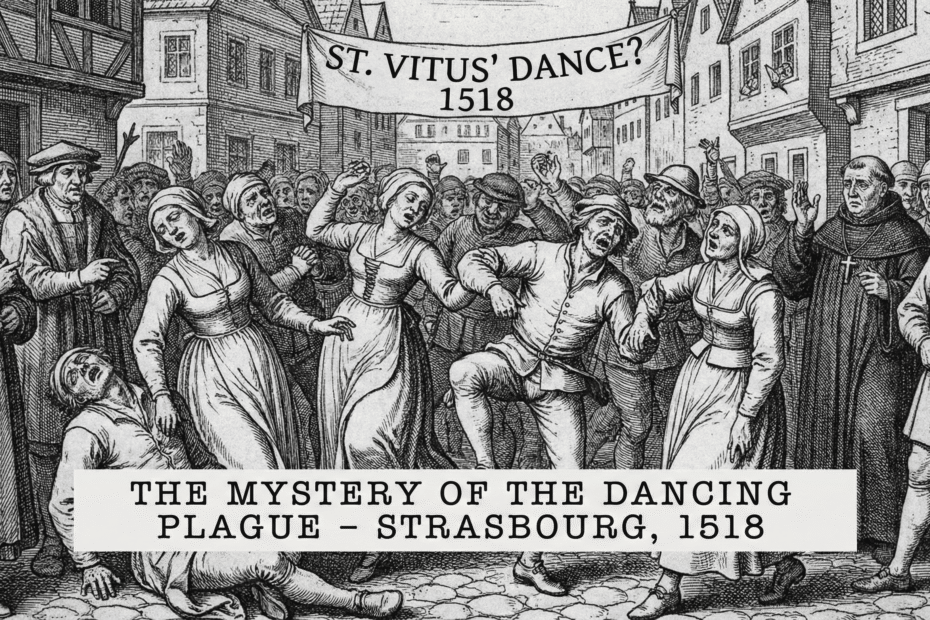
Title: The Dancing Plague of 1518: When an Entire City Danced to Death
Content:
In the scorching summer of 1518, the narrow cobblestone streets of Strasbourg bore witness to one of the most bizarre and terrifying phenomena in recorded history: a deadly epidemic where hundreds of people danced uncontrollably for weeks until their bodies collapsed from exhaustion, stroke, or heart failure.
The Nightmare Begins
The bizarre outbreak began in mid-July 1518, in the city of Strasbourg (then part of the Holy Roman Empire, in present-day France). A woman identified in municipal records as Frau Troffea stepped out of her home and suddenly began to dance frantically in the street.
There was no music playing, no festive occasion, and no joy on her face. She danced through the day and into the night, drenched in sweat, her shoes torn and feet bleeding. Even when fatigue overwhelmed her, her limbs continued to twitch and gyrate. After days of non-stop dancing, she was carried away, but the contagion had already taken root.
Within a week, more than thirty people joined the frenzied, involuntary dance. Within a month, the crowd swelled to over 400 citizens. Men, women, and children danced through the sweltering heat, trapped in a trance-like state they could neither understand nor halt.
A Deadly Prescription
As the crisis escalated, Strasbourg’s civic leaders and physicians scrambled for a solution. Ruling out astrological and demonic causes, local doctors concluded that the affliction was a natural disease caused by “hot blood” (an imbalance of the bodily humors).
Their recommended cure was astonishing: they believed the victims simply had to “dance it out of their systems” to purge the overheated blood.
Following this medical advice, city authorities constructed massive wooden platforms in the grain and horse markets, cleared guildhalls, and hired professional musicians—pipers, fifers, and drummers—to keep the rhythm going. Strong men were even employed to hold up fainting dancers so they could keep moving.
The strategy was a catastrophic failure. Instead of exhausting the dancers into recovery, the constant music and public spectacle fueled the mania. As the tempo quickened, dozens collapsed daily, suffering fatal strokes, heart attacks, dehydration, and ruptured blood vessels. At its peak, historical chronicles recorded that up to fifteen people were dying every single day.
The Wrath of Saint Vitus
Realizing their medical interventions were worsening the catastrophe, city officials banned public music and dancing, turning to religious remedies.
In 16th-century Europe, people lived under the shadow of famine, disease, and deep-seated religious dread. Many believed the epidemic was a curse sent by Saint Vitus, a Christian martyr believed to possess the power to punish sinners with uncontrollable dancing mania (chorea).
Desperate to lift the curse, authorities rounded up the surviving dancers and transported them in wagons to a remote mountain shrine dedicated to Saint Vitus near Saverne. There, the afflicted were given small red crosses and red shoes, led around the altar, sprinkled with holy water, and prayed over. Gradually, by late autumn, the bizarre mania began to subside, and the surviving dancers slowly returned to their senses.
Modern Theories: Poison or Mind?
Over the centuries, historians, toxicologists, and psychologists have investigated what really happened during the summer of 1518:
1. Ergot Poisoning (Ergotism)
An early modern theory suggested that the dancers were suffering from ergotism—poisoning caused by consuming rye flour contaminated with the toxic fungus *Claviceps purpurea*. Ergot contains alkaloids related to LSD, which can trigger hallucinations, vivid convulsions, and intense spasms (known historically as Saint Anthony’s Fire).
However, medical experts largely dismiss this theory. While ergot causes violent tremors and hallucinations, it severely constricts blood flow to the extremities, leading to gangrene. It would have been physiologically impossible for hundreds of poisoned individuals to perform strenuous, coordinated physical movements for days on end without their limbs turning necrotic.
2. Mass Psychogenic Illness (Mass Hysteria)
The most widely accepted explanation, championed by medical historian John Waller, points to mass psychogenic illness—a severe collective psychological breakdown triggered by extreme environmental stress.
In 1518, Strasbourg was reeling from catastrophic crop failures, severe famine, crushing poverty, and devastating outbreaks of smallpox and syphilis. The populace lived in an unbearable state of psychological trauma and spiritual terror. Deeply ingrained local superstitions held that displeasing Saint Vitus would bring a dancing curse upon them.
Under such immense, unyielding distress, a single vulnerable person entering a dissociative trance state acted as a social trigger. In a deeply superstitious environment, belief became biology—manifesting as a full-blown collective physical frenzy.
An Unsettling Legacy
The Dancing Plague of 1518 stands as a profound testament to the mysterious power of the human psyche. It demonstrates how acute collective fear, social trauma, and deep cultural belief can hijack the human nervous system, transforming psychological anguish into literal, fatal motion.
More than five centuries later, the silent streets of Strasbourg remind us of the fragile boundary between the conscious mind and the untamed power of collective belief.
Title: डांसिंग प्लेग 1518: जब नाचते-नाचते मरने लगे थे सैकड़ों लोग
Content:
सन 1518 की तपती गर्मियों में यूरोप के स्ट्रासबर्ग शहर की सड़कों पर इतिहास की सबसे अजीबोगरीब और रूह कंपा देने वाली त्रासदी घटी। सैकड़ों लोग बिना किसी संगीत या खुशी के हफ्तों तक बेतहाशा नाचते रहे—तब तक, जब तक कि दिल का दौरा पड़ने, स्ट्रोक या अत्यधिक थकान से उनके प्राण नहीं निकल गए। इसे इतिहास में “डांसिंग प्लेग ऑफ 1518” (Dancing Plague of 1518) के नाम से जाना जाता है।
खौफनाक सिलसिले की शुरुआत
यह रहस्यमयी घटना जुलाई 1518 के मध्य में शुरू हुई। स्ट्रासबर्ग (जो उस समय पवित्र रोमन साम्राज्य का हिस्सा था, वर्तमान में फ्रांस में स्थित है) की एक संकरी सड़क पर फ्राउ ट्रॉफिया (Frau Troffea) नाम की एक महिला अचानक पागलों की तरह नाचने लगी।
आसपास न कोई संगीत बज रहा था और न ही कोई उत्सव था। उसके चेहरे पर खुशी का नामोनिशान नहीं था, बल्कि एक अजीब सी बेबसी और खौफ था। वह लगातार दिन-रात नाचती रही। उसके कपड़े पसीने से भीग चुके थे और पैरों से खून बहने लगा था। कई दिनों तक बिना रुके नाचने के बाद जब वह निढाल हो गई, तो उसे इलाज के लिए ले जाया गया, लेकिन यह संक्रामक उन्माद शहर में फैल चुका था।
एक हफ्ते के भीतर तीस से ज्यादा लोग इस बेकाबू नाच में शामिल हो गए। महीने भर में यह संख्या 400 से अधिक हो गई। औरतें, मर्द और बच्चे चिलचिलाती धूप में बिना रुके थिरक रहे थे, मानो किसी अज्ञात शक्ति ने उनके शरीरों पर कब्जा कर लिया हो।
प्रशासन की अजीबोगरीब गलती
जब हालात बेकाबू हो गए, तो स्ट्रासबर्ग के प्रशासन और डॉक्टरों ने समाधान तलाशने की कोशिश की। डॉक्टरों ने इसे कोई शैतानी असर मानने से इनकार किया और इसे एक प्राकृतिक बीमारी बताया। उनके मुताबिक मरीजों की नसों में “गर्म खून” (Hot Blood) जमा हो गया था, जिसे निकालने के लिए लगातार नाचना ही एकमात्र उपाय था।
इस अजीबोगरीब चिकित्सा सलाह पर अमल करते हुए स्थानीय प्रशासन ने अनाज मंडियों और बाजारों में लकड़ी के बड़े-बड़े मंच बनवा दिए। गिल्ड हॉल खाली करा दिए गए और पेशेवर संगीतकारों—शहनाई वादकों और ढोलकियों—को बुलाया गया ताकि वे लगातार धुन बजाते रहें। यहां तक कि बेहोश होने वाले लोगों को सहारा देकर नचाने के लिए ताकतवर लोगों को तैनात किया गया।
यह फैसला बेहद विनाशकारी साबित हुआ। नाचने वाले ठीक होने के बजाय और ज्यादा उत्तेजित हो गए। भीड़ में यह उन्माद जंगल की आग की तरह फैल गया। चिलचिलाती धूप में नाचते-नाचते रोजाना दर्जनों लोग दिल का दौरा पड़ने, डिहाइड्रेशन और स्ट्रोक की वजह से जमीन पर गिरकर दम तोड़ने लगे। ऐतिहासिक दस्तावेजों के मुताबिक, चरम स्थिति में हर दिन 15 से ज्यादा लोगों की मौत हो रही थी।
सेंट विटस का प्रकोप या धार्मिक मान्यता?
जब संगीत और मंचों से मौत का आंकड़ा बढ़ने लगा, तो प्रशासन को अपनी गलती का अहसास हुआ। उन्होंने सार्वजनिक संगीत और नाच पर तुरंत पाबंदी लगा दी और धार्मिक उपायों की ओर रुख किया।
सोलहवीं सदी का समाज घोर अंधविश्वास, भूखमरी और महामारियों के साए में जी रहा था। आम लोगों का मानना था कि यह महामारी सेंट विटस (Saint Vitus) का श्राप है। मान्यता थी कि यदि कोई सेंट विटस को नाराज कर दे, तो वे सजा के तौर पर इंसान पर नाचने का पागलपन (कोरियोमेनिया) थोप देते हैं।
इस श्राप से मुक्ति पाने के लिए पीड़ितों को गाड़ियों में भरकर सेवरने (Saverne) की पहाड़ियों पर स्थित सेंट विटस के पवित्र तीर्थ स्थल ले जाया गया। वहां उन्हें लाल रंग के जूते पहनाए गए, पवित्र जल छिड़का गया और प्रार्थनाएं की गईं। धीरे-धीरे शरद ऋतु आते-आते यह खौफनाक उन्माद शांत हुआ और बचे हुए लोग सामान्य जिंदगी में लौट सके।
आधुनिक विज्ञान और डॉक्टरों की थ्योरी
इतिहासकारों, टॉक्सिकोलॉजिस्ट और मनोचिकित्सकों ने इस ऐतिहासिक पहेली को सुलझाने के लिए कई वैज्ञानिक सिद्धांत पेश किए हैं:
1. अरगट पॉइजनिंग (Ergotism)
शुरुआती दौर में वैज्ञानिकों का मानना था कि यह अरगट पॉइजनिंग का मामला हो सकता है। अरगट (Ergot) राई (Rye) की फसल पर उगने वाला एक जहरीला फंगस होता है, जिसमें एलएसडी (LSD) जैसा रासायनिक तत्व होता है। इसे खाने से मतिभ्रम (Hallucinations) और मांसपेशियों में तेज ऐंठन होती है।
हालांकि आधुनिक शोधकर्ताओं ने इस थ्योरी को खारिज कर दिया है। अरगट पॉइजनिंग से शरीर के अंगों में खून का संचार बंद हो जाता है और गैंग्रीन हो जाता है। ऐसे में किसी भी इंसान के लिए हफ्तों तक लगातार लयबद्ध तरीके से नाचना शारीरिक रूप से पूरी तरह असंभव है।
2. मास साइकोजेनिक इलनेस (सामूहिक हिस्टीरिया)
प्रसिद्ध इतिहासकार जॉन वॉलर के अनुसार, इसका सबसे सटीक कारण ‘मास साइकोजेनिक इलनेस’ यानी सामूहिक हिस्टीरिया था।
सन 1518 में स्ट्रासबर्ग के लोग भयंकर अकाल, कुपोषण, भारी गरीबी और सिफलिस व चेचक जैसी जानलेवा बीमारियों से जूझ रहे थे। चारों तरफ मौत और तबाही का खौफ था। इस भारी मानसिक तनाव और सेंट विटस के प्रकोप के गहरे धार्मिक डर ने लोगों के अवचेतन मन को जकड़ लिया। ऐसे अत्यधिक तनावपूर्ण माहौल में जब एक महिला समाधि जैसी स्थिति (Trance) में नाची, तो बाकी त्रस्त लोगों का दिमाग भी उसी दिशा में बह गया और यह सामूहिक मनोवैज्ञानिक त्रासदी में बदल गया।
दिमाग की अनसुलझी शक्ति
डांसिंग प्लेग ऑफ 1518 इस बात का सबसे डरावना उदाहरण है कि इंसान का दिमाग कितना शक्तिशाली हो सकता है। जब गहरा सदमा, सामाजिक तनाव और धार्मिक अंधविश्वास आपस में मिलते हैं, तो वे इंसानी शरीर की सीमाओं को तोड़कर उसे मौत के मुंह में धकेल सकते हैं।
पांच सदियों बाद भी स्ट्रासबर्ग की यह घटना इतिहास की सबसे रहस्यमयी और रोंगटे खड़े कर देने वाली घटनाओं में शुमार है।
Title: The Dancing Plague of 1518: Jab Log Naachte-Naachte Marne Lage
Content:
July 1518 ki ek garmiyon bhari dopahar ko Europe ke Strasbourg shahar mein ek aisi hairatangez ghatna shuru hui jiska khauf aaj bhi itihaas ke panno mein darz hai. Sadkon par achanak saikdon log bina kisi music ya celebration ke bekaabu hokar naachne lage — aur tab tak naachte rahe jab tak unka dil phat nahi gaya ya unka shareer thak kar hamesha ke liye shant nahi ho gaya.
Achanak Shuru Hua Khaufnak Silsila
Ye sab shuru hua jab Frau Troffea naam ki ek mahila achanak apne ghar se bahar aayi aur Strasbourg ki pathrili sadak par ajeeb tareeqe se naachne lagi.
Wahan na koi shaadi thi, na koi dhol-taasha aur na hi koi music. Uske chehre par khushi ki jagah ek khauf aur dard saaf dikh raha tha. Wo lagataar din-raat naachti rahi. Pasine se kapde bheege the aur pairon se khoon nikal raha tha, par uske shareer par uska koi bas nahi tha. Jab kayi dino baad wo behosh hokar giri toh use le jaya gaya, lekin tab tak ye bimari shahar mein aag ki tarah phail chuki thi.
Dekhte hi dekhte ek hafte mein 30 se zyada log is ajeeb trance mein shamil ho gaye. Aur ek mahine ke andar ye sankhya 400 se paar chali gayi. Aurtein, mard aur bacche — sabhi garmi mein bina ruke bas naache ja rahe the.
Doctors Ki Badi Galti Aur Badhta Maut Ka Khel
Jab haalaat haath se nikalne lage, toh shahar ke bade doctors aur prashasan ne aapas mein baithak ki. Doctors ne ise koi bhoot-pret nahi balki shareer ke “garam khoon” (hot blood) ki natural bimari bataya. Unka maanna tha ki agar in logon ko lagataar nachaya jaye toh naach-naach kar unka garam khoon thanda ho jayega aur wo theek ho jayenge.
Is ajeeb ilaj ke chakkar mein authorities ne anaj mandiyon mein lakdi ke bade dance stages banwa diye. Shahar ke mashhoor musicians, dholak aur shehnai bajane walon ko bulaya gaya taaki wo bina ruke dhun bajate rahein. Yahan tak ki jo log behosh hone lagte the, unhe pakad kar nachane ke liye pehalwan khade kar diye gaye.
Par is faisle ne tabahi macha di. Rhythmic music aur stages dekh kar bheed ka unmaad aur badh gaya. Log naachte-naachte heart attack, dehydration aur brain stroke se sadak par girne lage. Records ke mutabiq us daur mein har din 15 se zyada log naachte-naachte dum tod rahe the.
Saint Vitus Ka Shraap Ya Dharmik Dar?
Mauton ka aakda badhte dekh authorities ne music aur stages par turant ban laga diya aur dharmik raste talashne shuru kiye.
16th century ka Europe bhayanak bimariyon, akaal aur andhvishwas se ghira hua tha. Aam logon ka vishwas tha ki ye Saint Vitus ka shraap hai. Maanta thi ki agar Saint Vitus kisi paap ki wajah se gussa ho jayein, toh wo logon par naachne ka pagalpan bhej dete hain.
Is shraap se chutkara paane ke liye bache huye dancers ko gaadiyon mein baithakar Saverne ki pahadiyon par Saint Vitus ke temple le jaya gaya. Wahan unhe laal rang ke joote pehnaye gaye, holy water chhidka gaya aur pooja-paath kiya gaya. Dheere-dheere autumn aate-aate ye trance khatam hua aur log wapas hosh mein aane lage.
Modern Science Aur Theories Kya Kehti Hain?
Aaj ke daur ke doctors aur historians ne is ghatna ke peeche do main theories di hain:
1. Ergot Poisoning (Fungus Wala Anaaj)
Kuch experts ka sochna tha ki shayad logon ne rye (anaaj) par ugne wala zehreela fungus ‘Ergot’ khaa liya tha. Ergot ke andar LSD jaisa chemical hota hai jo hallucinations aur ajeeb daure paida karta hai.
Lekin modern medical science ne ise reject kar diya. Ergot poisoning hone par shareer ke hisson mein blood supply band ho jati hai aur gangrene ho jata hai. Aise haalaat mein kisi ke liye bhi hafton tak continuously naachna biologically possible hi nahi hai.
2. Mass Psychogenic Illness (Mass Hysteria)
Historian John Waller ke mutabiq, iska asli kaaran ‘Mass Hysteria’ tha.
1518 mein Strasbourg ke log bhookhmari, gareebi aur syphilis jaisi bimariyon se buri tarah toot chuke the. Log itne zyada mental stress aur Saint Vitus ke khauf mein the ki unka dimag ek dissociative trance mein chala gaya. Jab ek aurat ne us mahaul mein naachna shuru kiya, toh baki logon ka dimaag bhi usi psychological breakdown ka shikar ban gaya.
Insaani Dimag Ka Ek Anokha Raaz
Dancing Plague of 1518 is baat ka saboot hai ki extreme fear, trauma aur collective belief insaan ke physical body ko kis tarah control kar sakte hain.
500 saal beet jaane ke baad bhi, Strasbourg ki sadkon par hui ye ghatna science aur psychology ke liye ek aisi paheli hai jo aaj bhi logon ko hairan kar deti hai.