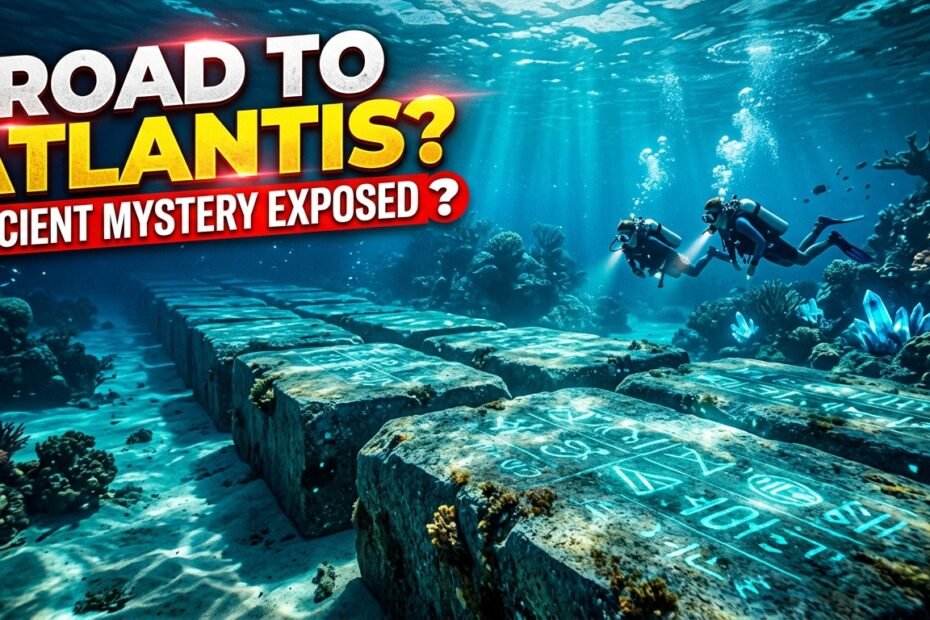
Deep beneath the turquoise waves of the Bahamas, just off the coast of North Bimini island, lies one of the ocean’s most baffling enigmas. Resting on the shallow seabed, roughly twenty feet down, is a half-mile-long formation of massive, neatly aligned limestone slabs. To the naked eye, it looks unmistakable: an ancient paved highway disappearing silently into the deep blue abyss.
The world first learned of this underwater marvel in September 1968. Marine biologist and archaeologist Dr. J. Manson Valentine was diving in the crystal-clear waters when he spotted what seemed impossible in nature. Beneath him stretched a submerged avenue of colossal rectangular stones, some measuring fifteen feet across and weighing several tons. The stones formed organized linear tracks, complete with deliberate right angles and sweeping curves. Valentine was convinced he had stumbled upon a man-made harbor or causeway submerged by prehistoric cataclysms.
What made Valentine’s discovery genuinely chilling was a prophecy made thirty years earlier. In the late 1930s, the renowned American mystic Edgar Cayce, known as the “Sleeping Prophet,” made a startling prediction during one of his trances. He claimed that the first remnants of the lost civilization of Atlantis would be discovered off the coast of Bimini, and he gave a specific timeframe: 1968 or 1969. When Valentine found the road in the exact year Cayce had foretold, a worldwide sensation ignited. Could this submerged road truly be the legendary lost empire of Atlantis?
The discovery immediately divided the scientific community. Mainstream geologists rushed to offer a natural explanation. They argued that the Bimini Road is merely “beachrock”—a type of sedimentary rock formed rapidly along coastlines under marine sediments. Over thousands of years, tidal forces, tectonic shifts, and thermal cracking could fracture the rock into remarkably neat, rectangular blocks, smoothed at the edges by relentless wave action.
Yet, alternative researchers and seasoned divers refuse to accept that nature alone is responsible. Expeditions led by investigators like Dr. David Zink in the 1970s revealed stacked blocks, mortar-like material, and distinct leveling stones placed underneath the massive slabs—features that defy standard geological erosion. Furthermore, satellite scans and sonar imaging have suggested the road may extend much further, connecting to other anomalous submerged structures across the Great Bahama Bank.
Today, more than half a century after its discovery, the Bimini Road remains an unsolved puzzle. Whether it is an astonishing trick of natural geology or the sunken remnant of a forgotten Golden Age, those who swim along its silent, sunlit stones cannot escape the uncanny feeling that someone, thousands of years ago, built a path where only fish now swim.
बहामास के फिरोजी समंदर की गहराइयों में, नॉर्थ बिमिनी द्वीप के तट से कुछ ही दूरी पर, पानी के नीचे छिपा है एक ऐसा रहस्य जिसने वैज्ञानिकों और इतिहासकारों को दशकों से हैरान कर रखा है। लगभग बीस फीट गहरे पानी में फैला करीब आधा मील लंबा यह रास्ता चूना पत्थर के विशाल, तराशे हुए चौकोर पत्थरों से बना नजर आता है। ऊपर से देखने पर यह किसी प्राचीन साम्राज्य का पक्का राजमार्ग प्रतीत होता है जो समंदर की अनंत गहराइयों में विलीन हो रहा हो।
इस जलमग्न संरचना की खोज सितंबर 1968 में समुद्री जीवविज्ञानी डॉ. जे. मैनसन वैलेंटाइन ने की थी। जब वे बिमिनी के साफ पानी में गोताखोरी कर रहे थे, तो उनकी नजर समुद्र तल पर बिछी एक हैरतअंगेज बनावट पर पड़ी। नीचे भारी-भरकम आयताकार पत्थरों की कतारें थीं, जिनमें से कई पत्थर 15 फीट लंबे और कई टन वजनी थे। इन पत्थरों की बनावट में सटीक समकोण और मोड़ देखकर वैलेंटाइन को पक्का यकीन हो गया कि यह कोई प्राकृतिक चट्टान नहीं, बल्कि किसी प्रागैतिहासिक सभ्यता का बनाया हुआ बंदरगाह या रास्ता है।
इस खोज से भी ज्यादा रोंगटे खड़े करने वाली बात थी तीस साल पहले की गई एक रहस्यमयी भविष्यवाणी। 1930 के दशक के अंत में, अमेरिका के मशहूर रहस्यवादी एडगर केसी—जिन्हें “स्लीपिंग प्रोफेट” कहा जाता था—ने समाधि की अवस्था में दावा किया था कि अटलांटिस के खोए हुए साम्राज्य के अवशेष सबसे पहले बिमिनी के तट पर सामने आएंगे। केसी ने साल भी बताया था: 1968 या 1969। और ठीक 1968 में डॉ. वैलेंटाइन ने इस रास्ते को ढूंढ निकाला। इस इत्तेफाक ने पूरी दुनिया में तहलका मचा दिया। क्या यह वाकई अटलांटिस का खोया हुआ रास्ता था?
इस खोज के बाद विज्ञान जगत दो गुटों में बंट गया। मुख्यधारा के भूवैज्ञानिकों का मानना है कि यह केवल एक प्राकृतिक घटना है, जिसे ‘बीच-रॉक’ कहा जाता है। उनके अनुसार, हजारों सालों में समुद्र की लहरों, दबाव और तापमान में बदलाव के कारण चट्टानें चौकोर टुकड़ों में टूट गईं और पानी के बहाव ने उनके कोनों को गोल कर दिया।
लेकिन कई शोधकर्ता और गोताखोर इस दलील से पूरी तरह सहमत नहीं हैं। 1970 के दशक में हुए अध्ययनों में देखा गया कि इन भारी पत्थरों के नीचे छोटे आधार पत्थर रखे गए थे ताकि सतह को समतल बनाया जा सके। कुछ हिस्सों में दोहरी परतें भी पाई गईं, जो प्राकृतिक रूप से बनना नामुमकिन सा लगता है।
आज भी ‘बिमिनी रोड’ इतिहास का एक अनसुलझा सवाल बनी हुई है। चाहे यह कुदरत की कोई नायाब कारीगरी हो या फिर किसी भूली-बिसरी महान सभ्यता का अवशेष, जो भी गोताखोर इस शांत, डूबे हुए रास्ते पर तैरता है, वह एक अजीब सा सम्मोहन और विस्मय महसूस किए बिना नहीं रह सकता।
Bahamas ke crystal clear turquoise paani ke neeche, North Bimini island ke paas ek aisi underwater structure maujood hai jisne saalon se scientists aur explorers ke hosh uda rakhe hain. Samandar ke surface se lagbhag 20 feet neeche, adha mile lamba ek paved pathway dikhai deta hai jo bilkul kisi ancient highway jaisa lagta hai. Isse duniya “Bimini Road” ke naam se jaanti hai.
Kahani shuru hoti hai September 1968 mein. Marine biologist Dr. J. Manson Valentine Bimini ke saaf paani mein diving kar rahe the. Achanak unki nazar seabed par bichhe massive limestone blocks par padi. Yeh koi aam pathar nahi the—yeh perfect rectangular slabs the, jinme se kayi 15 feet tak lambe aur kai ton bhaari the. Yeh blocks ekdum line se arrange kiye gaye the, jinme clean right angles aur curves saaf dikh rahe the. Valentine ko pehli hi nazar mein lag gaya ki yeh nature ka kaam nahi, balki insano ka banaya hua koi ancient harbor ya road hai.
Lekin is mystery ka sabse ajeeb panna juda hai ek 30 saal purani prophecy se. 1930s ke aakhir mein, America ke famous mystic Edgar Cayce—jinhe “Sleeping Prophet” kaha jata tha—ne trance state mein ek prediction ki thi. Unhone kaha tha ki lost civilization Atlantis ke pehle traces Bimini ke paas milenge, aur unhone saal bhi bataya tha: 1968 ya 1969. Aur theek 1968 mein Dr. Valentine ne is submerged road ko discover kar liya. Is prediction aur discovery ke coincidence ne pure world media mein aag laga di.
Geologists ne foran is theory ko reject kiya aur kaha ki yeh sirf “beachrock” hai—jo marine sediments se naturally banti hai. Unka logic tha ki hazaron saalon ke tidal pressure aur thermal cracks ki wajah se yeh rocks rectangular shapes mein break ho gaye aur paani ke current ne unke edges smooth kar diye.
Lekin alternative researchers aur scuba divers is explanation se convince nahi hue. 1970s mein Dr. David Zink aur unki team ne underwater expeditions kiye, jahan unhe pata chala ki in giant slabs ke neeche chote leveling stones rakhe gaye the surface ko balance karne ke liye. Kuch areas mein stones ki double layers bhi mili jo naturally banna lagbhag impossible lagta hai.
Aadha century beetne ke baad bhi, Bimini Road ek solid enigma bani hui hai. Kya yeh nature ka banaya ek rare geological illusion hai, ya phir kisi aisi lost civilization ka blueprint jo sadiyon pehle paani mein dafan ho gayi? Iska jawab aaj bhi samandar ke sannate mein dafan hai.