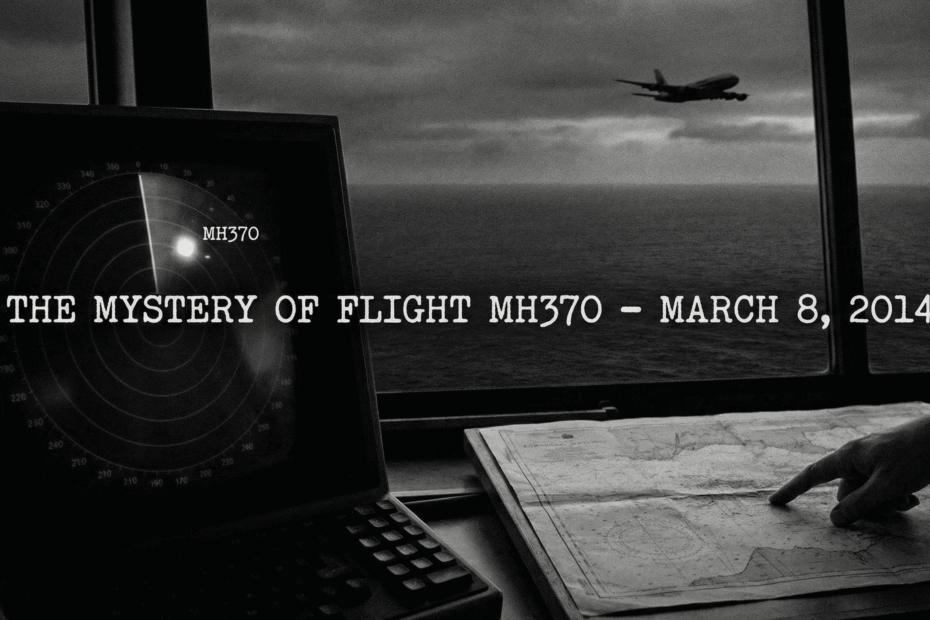
The Mystery of Flight MH370: The Disappearance That Baffled the World
On March 8, 2014, modern aviation witnessed its most perplexing and haunting tragedy. Malaysia Airlines Flight 370 (MH370), a Boeing 777-200ER carrying 239 passengers and crew, vanished from radar screens mid-flight on a routine journey from Kuala Lumpur to Beijing. Over a decade later, despite the most extensive and expensive search operation in history, the main wreckage and the flight data recorders have never been found, leaving behind a chilling void and countless unanswered questions.
A Routine Midnight Departure
Flight MH370 departed Kuala Lumpur International Airport at 12:41 AM local time, heading northeast toward Beijing Capital International Airport. Weather conditions were calm, the aircraft was in excellent mechanical health, and the cockpit was commanded by two experienced aviators—53-year-old veteran Captain Zaharie Ahmad Shah and 27-year-old First Officer Fariq Abdul Hamid.
For the first 40 minutes, everything proceeded strictly by the book. The plane climbed smoothly to its cruising altitude of 35,000 feet across the South China Sea.
The Final Words and the Silent Turn
At 1:19 AM, as MH370 approached the boundary between Malaysian and Vietnamese airspace, Malaysian air traffic controllers signed off:
“Malaysian Three Seven Zero, contact Ho Chi Minh 120.9. Good night.”
From the cockpit came the calm, final voice transmission:
“Good night, Malaysian Three Seven Zero.”
Seconds later, the aircraft entered a communication “blind spot” between airspace control zones. What happened next was both sudden and baffling. The plane’s transponder was manually switched off, abruptly cutting off identification and altitude signals from civilian secondary radar. The aircraft never checked in with air traffic control in Ho Chi Minh City.
The Ghost Flight: Vanishing into the Night
While civilian radar lost track of the plane, military radar data later revealed a shocking discovery: MH370 did not plummet from the sky. Instead, it executed a deliberate, sharp left turn, flying back southwest across the Malay Peninsula, navigating around waypoint markers, and cruising northwest up the Strait of Malacca toward the Andaman Sea.
Aviation experts emphasized that such complex navigation could not be the result of a random autopilot malfunction or sudden structural failure—it required deliberate human intervention in the cockpit.
The Satellite “Handshakes”
With communication systems shut down, MH370 was seemingly invisible. However, an unexpected trail of breadcrumbs was preserved by an Inmarsat satellite orbiting over the Indian Ocean. Every hour, a ground station sent an automated electronic check-in (“ping” or handshake) to the aircraft’s satellite communication terminal. The terminal on MH370 automatically responded.
By analyzing the timing and frequency Doppler shifts of these seven hourly handshakes, engineers and mathematicians established that MH370 turned south and flew for nearly six hours after disappearing from military radar. It flew until its fuel was completely exhausted, terminating somewhere along a vast, remote arc in the southern Indian Ocean, west of Perth, Australia.
The Search: A Needle in a 120,000-Square-Kilometre Haystack
The search for MH370 became the largest and most technologically advanced underwater search in aviation history. Coordinated by the Australian Transport Safety Bureau (ATSB) alongside Malaysia and China, ships equipped with advanced sonar, autonomous underwater vehicles, and deep-tow systems mapped more than 120,000 square kilometres of treacherous, unexplored ocean floor.
Between 2015 and 2017, physical evidence finally surfaced thousands of kilometres away:
– In July 2015, a 2-metre wing component known as a flaperon washed ashore on Réunion Island in the western Indian Ocean.
– Subsequent fragments, including engine cowlings, flap fairings, and cabin interior panels, were discovered on coastlines in Mozambique, Tanzania, South Africa, and Madagascar.
– Oceanographic drift modeling confirmed that these pieces had drifted west across the Indian Ocean from the suspected southern impact zone.
Yet, despite private expeditions by companies like Ocean Infinity using state-of-the-art robotic submersibles, the primary fuselage, engines, and black boxes remained undiscovered beneath abyssal trenches.
Leading Theories: What Happened on Board?
Dozens of hypotheses have been debated by investigators, engineers, and aviation analysts:
1. Pilot Diversion and Deliberate Action
One prominent theory suggests deliberate human action from within the flight deck. Flight simulator data found at Captain Zaharie’s home included a simulated route ending in the southern Indian Ocean, though investigators could not conclusively link it to the actual flight path. No political manifesto, ransom demand, or conclusive motive was ever identified.
2. Catastrophic Decompression or Fire
Another scenario points to a sudden onboard emergency, such as rapid depressurization, a cargo fire involving lithium-ion batteries, or electrical failure. Proponents argue the pilots attempted to turn back to the nearest suitable runway before being overcome by hypoxia (oxygen deprivation), leaving the aircraft to fly as a “ghost plane” on autopilot until fuel exhaustion. However, critics argue hypoxia fails to explain the precise turns through navigational waypoints after transponder shutdown.
3. Hijacking or External Intervention
The possibility of unauthorized cockpit entry or electronic tampering has been proposed, but no passenger had known militant affiliations, and no group ever claimed responsibility.
The Enduring Enigma
The disappearance of MH370 catalyzed major global reforms in commercial aviation, leading to mandates for real-time aircraft tracking, extended underwater locator beacon battery life, and autonomous distress tracking systems.
Yet, for the families of the 239 souls on board, closure remains out of reach. MH370 stands as a haunting reminder of the sheer vastness of our planet’s oceans—and how, even in the era of pervasive satellite surveillance, a modern airliner could vanish into thin air.
मलेशिया एयरलाइंस फ्लाइट MH370 का रहस्य: आधुनिक विमानन इतिहास की सबसे बड़ी अनसुलझी पहेली
8 मार्च 2014 की रात आधुनिक विमानन के इतिहास की सबसे दर्दनाक और हैरान कर देने वाली रात साबित हुई। कुआलालंपुर से बीजिंग के लिए रवाना हुआ मलेशिया एयरलाइंस का विमान ‘फ्लाइट MH370’ (बोइंग 777-200ER) उड़ान भरने के कुछ ही समय बाद रडार से पूरी तरह गायब हो गया। इस विमान में 239 यात्री और क्रू सदस्य सवार थे। कई सालों की सघन तलाशी और आधुनिकतम तकनीक के इस्तेमाल के बावजूद, आज तक इस विमान का मुख्य मलबा और ब्लैक बॉक्स नहीं मिल सका है।
एक सामान्य रात और अचानक खामोशी
फ्लाइट MH370 ने आधी रात के बाद 12:41 बजे कुआलालंपुर इंटरनेशनल एयरपोर्ट से बीजिंग के लिए उड़ान भरी थी। मौसम साफ था, विमान तकनीकी रूप से पूरी तरह दुरुस्त था और कॉकपिट में 53 वर्षीय अनुभवी कैप्टन ज़ाहरी अहमद शाह और 27 वर्षीय फर्स्ट ऑफिसर फारिक अब्दुल हामिद मौजूद थे।
उड़ान के पहले 40 मिनट सब कुछ तय योजना के अनुसार चला। विमान 35,000 फीट की ऊंचाई पर दक्षिण चीन सागर के ऊपर सामान्य गति से उड़ रहा था।
कॉकपिट से आखिरी संदेश
रात 1:19 बजे, जब विमान मलेशियाई एयरस्पेस से वियतनाम के एयरस्पेस में प्रवेश करने वाला था, मलेशियाई एयर ट्रैफिक कंट्रोलर ने संपर्क समाप्त करते हुए कहा:
“मलेशियाई थ्री सेवन ज़ीरो, हो ची मिन्ह से 120.9 पर संपर्क करें। गुड नाइट।”
कॉकपिट से बेहद शांत आवाज में अंतिम जवाब आया:
“गुड नाइट, मलेशियन थ्री सेवन ज़ीरो।”
इसके ठीक बाद विमान दोनों देशों के नियंत्रण क्षेत्रों के बीच एक क्षणिक ब्लाइंड स्पॉट में पहुंचा। अचानक विमान का ट्रांसपोंडर (जो नागरिक रडार पर विमान की पहचान और ऊंचाई भेजता है) बंद कर दिया गया। वियतनाम के एयर ट्रैफिक कंट्रोल को विमान की तरफ से कोई कॉल नहीं मिली और MH370 नागरिक रडार से पूरी तरह ओझल हो गया।
रहस्यमयी यू-टर्न और ‘घोस्ट फ्लाइट’
सिविलियन रडार से गायब होने के बाद जब सैन्य रडार (Military Radar) डेटा की जांच की गई, तो एक चौंकाने वाला सच सामने आया। विमान समुद्र में तुरंत क्रैश नहीं हुआ था, बल्कि उसने एक तेज बाईं ओर का मोड़ (Sharp Left Turn) लिया था। वह मलय प्रायद्वीप के ऊपर से वापस पश्चिम की ओर मुड़ा और मलक्का जलडमरूमध्य (Strait of Malacca) होते हुए अंडमान सागर की ओर निकल गया।
विमानन विशेषज्ञों के अनुसार, इतनी सटीकता से दिशा बदलना किसी तकनीकी खराबी या ऑटोपायलट एरर का नतीजा नहीं हो सकता था; इसे कॉकपिट में मौजूद किसी व्यक्ति द्वारा जानबूझकर नियंत्रित किया गया था।
सैटेलाइट ‘हैंडशेक’ और हिंद महासागर का सुराग
संचार व्यवस्था बंद होने के बावजूद, हिंद महासागर के ऊपर स्थित ‘इनमारसैट’ (Inmarsat) उपग्रह ने एक अहम कड़ी दर्ज की। ग्राउंड स्टेशन और विमान के सैटेलाइट टर्मिनल के बीच हर घंटे एक ऑटोमैटिक इलेक्ट्रॉनिक सिग्नल (हैंडशेक या पिंग) का आदान-प्रदान हो रहा था।
इन 7 घंटों के सिग्नलों के वैज्ञानिक विश्लेषण और डॉपलर प्रभाव से पता चला कि रडार से हटने के बाद भी MH370 लगभग 6 घंटे तक लगातार उड़ता रहा। वह दक्षिण की ओर बढ़ते हुए दक्षिणी हिंद महासागर के अत्यंत दुर्गम इलाके में उस वक्त तक उड़ता रहा जब तक कि उसका सारा ईंधन समाप्त नहीं हो गया।
इतिहास का सबसे बड़ा और महंगा खोज अभियान
MH370 की तलाश के लिए ऑस्ट्रेलिया, मलेशिया और चीन के नेतृत्व में इतिहास का सबसे बड़ा बहुराष्ट्रीय सर्च ऑपरेशन चलाया गया। आधुनिक सोनार, ऑटोनॉमस सबमर्सिबल और डीप-टो सिस्टम से लैस जहाजों ने दक्षिणी हिंद महासागर के 1,20,000 वर्ग किलोमीटर से अधिक दुर्गम समुद्री तल को खंगाला।
2015 से 2017 के बीच हजारों किलोमीटर दूर पश्चिमी हिंद महासागर के तटों पर कुछ सुराग मिले:
– जुलाई 2015 में रीयूनियन द्वीप के तट पर विमान के पंख का एक हिस्सा (फ्लैपरॉन) बहकर आया।
– इसके बाद मोज़ाम्बिक, तंजानिया, मेडागास्कर और दक्षिण अफ्रीका के तटों पर विमान के लगभग 30 छोटे-बड़े टुकड़े मिले, जिनकी पुष्टि MH370 के मलबे के रूप में हुई।
महासागरीय धाराओं के अध्ययन से साबित हुआ कि ये टुकड़े उसी दक्षिणी हिंद महासागर से बहकर आए थे। लेकिन विमान का मुख्य ढांचा, इंजन और ब्लैक बॉक्स आज तक गहरे समुद्र की खाइयों में दफन हैं।
प्रमुख थ्योरीज़: आखिर उस रात क्या हुआ?
जांचकर्ताओं और विशेषज्ञों ने इस घटना को लेकर कई संभावित कारण सामने रखे हैं:
1. पायलट द्वारा जानबूझकर किया गया कदम:
कुछ जांचकर्ताओं का मानना है कि कैप्टन ने जानबूझकर विमान का मार्ग बदला और उसे दूरस्थ समुद्र में ले गए। उनके घर के फ्लाइट सिम्युलेटर में दक्षिणी हिंद महासागर का एक रूट मिला था, हालांकि इसके पीछे के ठोस मकसद या राजनीतिक इरादे का कोई पुख्ता प्रमाण नहीं मिला।
2. केबिन में ऑक्सीजन की कमी (हाइपोक्सिया) या आग:
एक अन्य थ्योरी के अनुसार, विमान में अचानक आग लगने या दबाव घटने (Depressurization) से पायलट तुरंत नजदीकी हवाई अड्डे की तरफ मुड़े, लेकिन ऑक्सीजन की कमी के कारण वे बेहोश हो गए। इसके बाद विमान ऑटोपायलट पर ईंधन खत्म होने तक उड़ता रहा। हालांकि, यह थ्योरी रडार पर दर्ज किए गए जटिल मोड़ों को पूरी तरह स्पष्ट नहीं कर पाती।
3. हाइजैकिंग या बाहरी हस्तक्षेप:
विमान के अपहरण की आशंका पर भी जांच हुई, लेकिन विमान में सवार किसी भी यात्री का आतंकी संगठनों से संबंध नहीं निकला और न ही किसी समूह ने इसकी जिम्मेदारी ली।
एक अनसुलझा सवाल
फ्लाइट MH370 की इस रहस्यमयी घटना ने वैश्विक नागरिक उड्डयन सुरक्षा और विमान ट्रैकिंग नियमों में क्रांतिकारी बदलाव किए। लेकिन उन 239 परिवारों के लिए आज भी यह सवाल जस का तस बना हुआ है कि उनके प्रियजनों के साथ आखिर हुआ क्या था।
सैटेलाइट और डिजिटल युग के बावजूद एक विशालकाय हवाई जहाज का अचानक गायब हो जाना यह साबित करता है कि प्रकृति और इंसानी दिमाग के कुछ रहस्य आज भी हमारी समझ से परे हैं।
Flight MH370 Ka Rahasya: Aviation History Ka Sabse Bada Unsolved Mystery
8 March 2014 ki aadhi raat ko ek aisa hadsa hua jisne poori duniya ke aviation experts, scientists aur security agencies ko hairan karke rakh diya. Malaysia Airlines ki flight MH370, jo ek modern Boeing 777-200ER aircraft thi, 239 logon ko lekar Kuala Lumpur se Beijing ke liye nikli thi. Lekin udaan bharne ke kuch hi der baad ye vishal plane achanak aasmaan se bina kisi trace ke gayab ho gaya.
Aaj ek dashak se zyada samay beet chuka hai, aur itne saalon mein duniya ka sabse mehanga search operation chalane ke baad bhi, na toh MH370 ka main wreckage mila aur na hi uska black box.
Kuala Lumpur Se Aakhiri Alvida
Flight MH370 ne 8 March 2014 ko raat ke 12:41 baje Kuala Lumpur International Airport se Beijing ke liye take-off kiya. Mausam bilkul saaf tha, plane ka maintenance record behtareen tha, aur cockpit mein do kabil pilots the—53 saal ke veteran Captain Zaharie Ahmad Shah aur 27 saal ke First Officer Fariq Abdul Hamid.
Shuruat ke 40 minute sab kuch standard operating procedure ke mutabiq chal raha tha. Plane bina kisi pareshani ke 35,000 feet ki cruising altitude par pahunch chuka tha.
Aakhiri Transmission Aur Achanak Khamoshi
Raat ke theek 1:19 baje, jab flight Malaysian airspace se nikal kar Vietnamese airspace mein enter karne wali thi, Malaysian Air Traffic Control ne handover karte hue message bheja:
“Malaysian Three Seven Zero, contact Ho Chi Minh 120.9. Good night.”
Cockpit se aakhiri reply aaya:
“Good night, Malaysian Three Seven Zero.”
Ye wo aakhiri aawaz thi jo duniya ne MH370 se suni. Iske theek baad, jab plane dono deshon ke airspace ke beech ek aam communication gap mein tha, plane ka transponder manual tarike se switch off kar diya gaya. Secondary civilian radar se plane ki altitude aur speed ka data achanak gayab ho gaya, aur Ho Chi Minh air traffic control se flight ne kabhi contact hi nahi kiya.
Military Radar Ka Shocking Khulasa
Civilians ke liye plane gayab tha, lekin jab baad mein military primary radar ka record check kiya gaya toh ek hairan kar dene wali baat saamne aayi. MH370 samandar mein gira nahi tha, balki usne achanak ek sharp left turn liya tha.
Plane ne apna rasta badal kar wapas Malay Peninsula ko cross kiya, navigation waypoints ko follow karte hue Strait of Malacca ke upar se guzar gaya aur Andaman Sea ki taraf badh gaya. Experts ka kehna hai ki itna precise aur technical route change kisi mechanical failure ya autopilot glitch se nahi ho sakta—ise cockpit ke andar se hi kisi experienced hath ne deliberately fly kiya tha.
Satellite Pings Aur Southern Indian Ocean Ka Track
Saare communications band hone ke baad lag raha tha ki plane ka koi clue nahi milega. Lekin ek invisible digital connection abhi bhi zinda tha. Indian Ocean ke upar tair rahe Inmarsat satellite ke sath plane ka communication unit har ek ghante mein automated electronic ‘handshake’ (ping) exchange kar raha tha.
Scientists ne in pings ke timing aur Doppler frequency shifts ko analyze karke calculate kiya ki military radar se hatne ke baad bhi MH370 lagbhag 6 ghante tak lagatar udta raha. Wo seedha dakshin ki taraf gaya aur Southern Indian Ocean ke behad sunsaan aur gehre ilaqe mein jaakar gira, jahan uska pura fuel khatam ho chuka tha.
Samandar Mein Sabse Badi Khoj
MH370 ko dhoondhne ke liye Australia, Malaysia aur China ne milkar human history ka sabse advanced aur mehanga underwater search operation shuru kiya. Modern sonar, autonomous underwater drones aur deep-sea vessels ne 1,20,000 square kilometers se zyada gehre samandar ke floor ko scan kiya, lekin main wreckage ka koi nishaan nahi mila.
Halanki, saalon baad ocean currents ke zariye baha kar laye gaye kuch fragments zaroor mile:
– July 2015 mein western Indian Ocean ke Réunion Island par plane ke wing ka ek part (flaperon) mila.
– Iske baad Mozambique, Tanzania, Madagascar aur South Africa ke beaches par plane ke lagbhag 30 se zyada confirmed pieces mile.
In pieces ne ye toh confirm kar diya ki plane crash hokar samandar mein bikhar gaya tha, par main fuselage aur black box aaj bhi hazaron meter gehre samandar ki khamoshi mein dabe hue hain.
Leading Theories: Kya Hua Hoga Cockpit Mein?
Is hadse ke peeche kai alag-alag theories di gayi hain:
1. Deliberate Pilot Action:
Kuch investigators ka manna hai ki Captain Zaharie ne janboojhkar plane ko remote Indian Ocean mein crash kiya. Unke ghar ke computer simulator se Indian Ocean ka ek simulated route bhi recover hua tha. Lekin kisi suicide note, financial trouble ya political motive ka koi conclusive proof nahi mila.
2. Sudden Hypoxia Aur Ghost Flight:
Ek doosri theory ye hai ki cabin mein achanak depressurization ya slow fire ki wajah se pilots ne emergency turn liya, lekin oxygen ki kami (hypoxia) se sabhi behosh ho gaye. Iske baad plane ghost flight ban kar autopilot par udta raha jab tak fuel exhaust nahi ho gaya. Lekin ye theory transponder band karne aur multiple turns lene ki timing ko poori tarah explain nahi karti.
3. Hijacking Ya Third-Party Tampering:
Shuru mein hijacking ka shaq bhi gaya tha, par plane ke kisi bhi passenger ka crime ya extremist network se link nahi nikla aur na hi kisi ne iski responsibility claim ki.
Modern Technology Par Ek Bada Sawaal
MH370 ke gayab hone ke baad global aviation rules mein kafi badlaav kiye gaye—jaise satellite-based real-time flight tracking aur extended underwater locator beacon battery life.
Lekin 239 parivaron ke liye ye dard aur intezar aaj bhi wahi hai. 21st century ke digital era mein, jahan har smartphone live track hota hai, ek 250-ton ka commercial jetliner achanak gayab ho jana hume yaad dilata hai ki samandar ki gehraiyan aur insani faisle kitne anboojh ho sakte hain.